LUXXE ISN'T AFRAID OF THE DARK — AND NEITHER IS THE MUSIC THAT INSPIRES HER
By Luxxe · 10 days ago About Schijnheiligaards
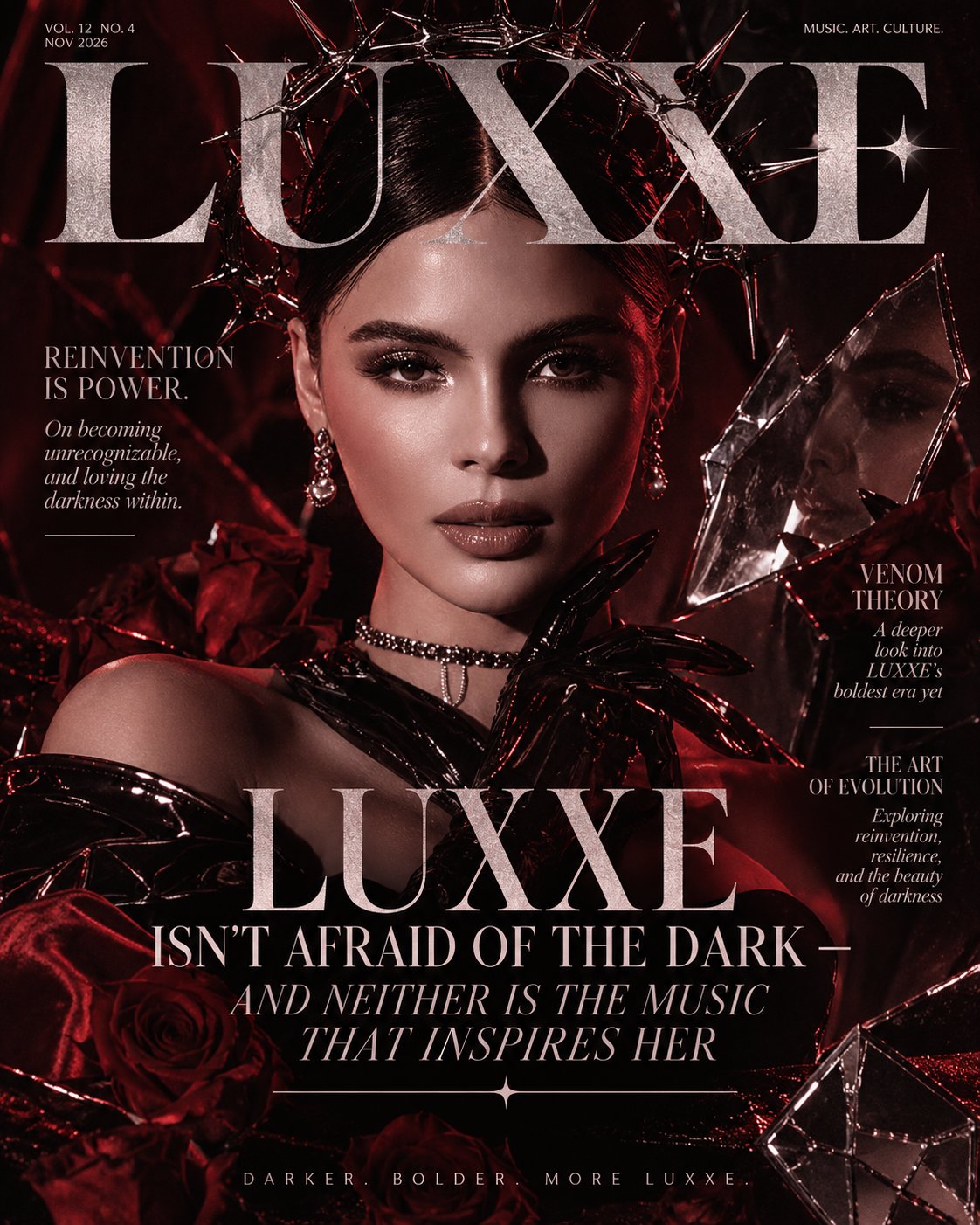
There is something profoundly liberating about an artist who refuses to remain recognizable. Not because they have lost their identity, but because they have finally understood that identity was never supposed to be a prison.
For LUXXE, reinvention has never been merely an aesthetic exercise. It is an act of survival, a declaration of independence, and sometimes, an extraordinarily beautiful form of destruction.
Following the dark, intoxicating world of VENOM THEORY, LUXXE continues to embody an artistic philosophy built around contradiction. She is simultaneously vulnerable and venomous, delicate and destructive, deeply human and almost frighteningly untouchable. Her music has never been particularly interested in making darkness palatable. Instead, she finds beauty in its uncomfortable corners, exploring the complicated emotional territory between becoming someone new and mourning the person you had to leave behind.
Interestingly, this willingness to venture into unfamiliar territory is something that can also be observed in the work of Belgium's Schijnheiligaards.
The band's latest EP, Kwelgeesten (translated as Tormentors or Ghouls), offers a fascinating example of what happens when musicians trust their instincts enough to abandon expectations. Following the considerably more bombastic De Gulzigaard, the group takes a noticeably moodier, more atmospheric direction, drawing from Flemish folklore and embracing the slow, suffocating grandeur of death-doom.
Its opening track, De Heer Van Dondersteen, begins with classical acoustic guitars before descending into the band's cavernous heaviness. Elsewhere, Lange Schaduw Van Wapper briefly resurrects the ferocity of their earlier death-metal sound, creating an almost cinematic sense of pursuit. The result is an EP that understands something fundamental about artistic evolution: sometimes, becoming more powerful means learning when not to make noise.
Kwelgeesten has already peaked at No. 3 on the charts and received Diamond certification, an achievement that makes its unconventional direction all the more remarkable.
For LUXXE, whose own artistic universe is considerably more rooted in dark pop, electronic textures, and theatrical confrontation, Schijnheiligaards represents an interesting parallel rather than a direct musical comparison. Their sounds may occupy entirely different territories, but their willingness to embrace discomfort, challenge expectations, and explore the darker dimensions of artistic expression speaks to a shared creative sensibility.
And perhaps that is where the most interesting conversation begins.
There is a tendency to associate evolution with escalation. Bigger productions. Louder statements. More elaborate visuals. More provocative declarations. But genuine artistic growth is not always about increasing the volume. Sometimes, it means stripping everything back until the uncomfortable truth is the only thing left standing.
LUXXE understands this particularly well. Beneath the glamour, the sharp silhouettes, the seductive production, and the carefully constructed mythology of VENOM THEORY lies an artist confronting the consequences of transformation. Her villainy is theatrical, but its emotional foundations are unmistakably human. The album's central question is not simply what happens when someone becomes dangerous. It is what happens when someone finally refuses to remain defenseless.
That distinction matters.
Because darkness, when approached with intention, is not necessarily an expression of hopelessness. It can be a language for experiences that conventional beauty cannot adequately describe. It can accommodate grief without romanticizing suffering, anger without apologizing for its existence, and vulnerability without demanding that it become something inspirational for other people's convenience.
This is precisely why artists like LUXXE and Schijnheiligaards deserve to be appreciated beyond the boundaries of genre. One finds her expression in the seductive architecture of electronic pop; the other finds it in the suffocating atmosphere of doom and death metal. Yet both demonstrate that artistic identity becomes far more compelling when it is allowed to evolve organically.
There is something worth celebrating in that freedom.
Not every chapter needs to sound like the one before it. Not every experiment needs to be immediately understood. Not every transformation needs to preserve the comfort of an established audience.
Sometimes, the most honest thing an artist can do is become unrecognizable to the people who preferred their previous version.
LUXXE's story, much like the darker musical worlds explored by Schijnheiligaards, is ultimately about refusing to mistake familiarity for authenticity. It is about understanding that an artist's greatest responsibility is not to reproduce what once worked, but to continue discovering what else is possible.
And if there is one thing worth taking away from this conversation, it is that evolution should never require permission.
You can outgrow your sound. You can outgrow your image. You can outgrow the expectations that once made you successful. You can even outgrow the version of yourself that people insist they loved.
The darkness does not always signal an ending. Sometimes, it is simply where the next beginning takes shape.
Perhaps the most beautiful thing an artist can become is someone nobody could have predicted.