one-trick pony ⇄ The Break
By one-trick pony ⇄ ★ · 15 days ago About ‘Superfluous Ornamentation on a Skeleton of Thought’, their single
The Notice on the Brick Wall
The announcement wasn’t a press release. It was a poster, wheat-pasted onto the brick wall outside the Cornershop in Salford where the band played their first gig, printed in the same smudged black ink as every flyer they had ever made. Two arrows pointing in opposite directions, ⇄, and underneath them, six words:
BACK WHEN WE KNOW WHAT’S NEXT.
By noon it had been photographed four thousand times. By evening, the tastemakers who had spent a decade calling them a one-trick pony were writing think pieces about the trick.
The band had earned the right to be unbothered. Six number ones. Twenty top ten hits. Sixteen platinum records and seven diamond - 600 million records in total sold. They had done it without once apologising for the formula: a chiming, wounded guitar hook, a chorus built like a terrace chant, and a post-punk shrug underneath it all, as if the song knew it was being too catchy and didn’t care.
Then, in the spring of that final tour year, the trick stopped working. Not commercially. Creatively. And the four of them had to find out whether there was anything behind it.

Where It Started
Julian Vance wrote the first song on a bus between Stockport and Manchester, on the back of a ticket stub, because he couldn’t afford a notebook and wouldn’t ask his mum for one.
“It was four chords and a lie,” Julian says now. “The lie was that I knew what I was talking about. I was nineteen. I’d never been properly heartbroken, never been anywhere. But the hook was right. I knew the hook was right the way you know a step is missing in the dark.”
Bea Thorne answered the ad he’d stuck up in a rehearsal-room stairwell.
Singer seeks guitarist who hates solos. Must be able to make a Telecaster sound like it’s apologising.
“I turned up to prove him wrong,” Bea says. “I hated being told what I’d hate. So I played him the most beautiful, ridiculous, eight-minute solo I could manage, and when I finished he just said, ‘Do that, but in four bars.’ And he was right. Annoyingly. That’s the whole band, really. Somebody saying do that, but smaller, and being right.”
Cal Mercer came next, a bassist who’d been fired from three covers bands for playing “too much like he meant it.” Tobes Higgins, a drummer who kept time with the kind of unfussy precision that made people think he was bored, completed the line-up inside a month.
“I wasn’t bored,” Tobes says. “I was saving it. Everyone else wanted to show off. I wanted every fill to feel like it cost me something.”
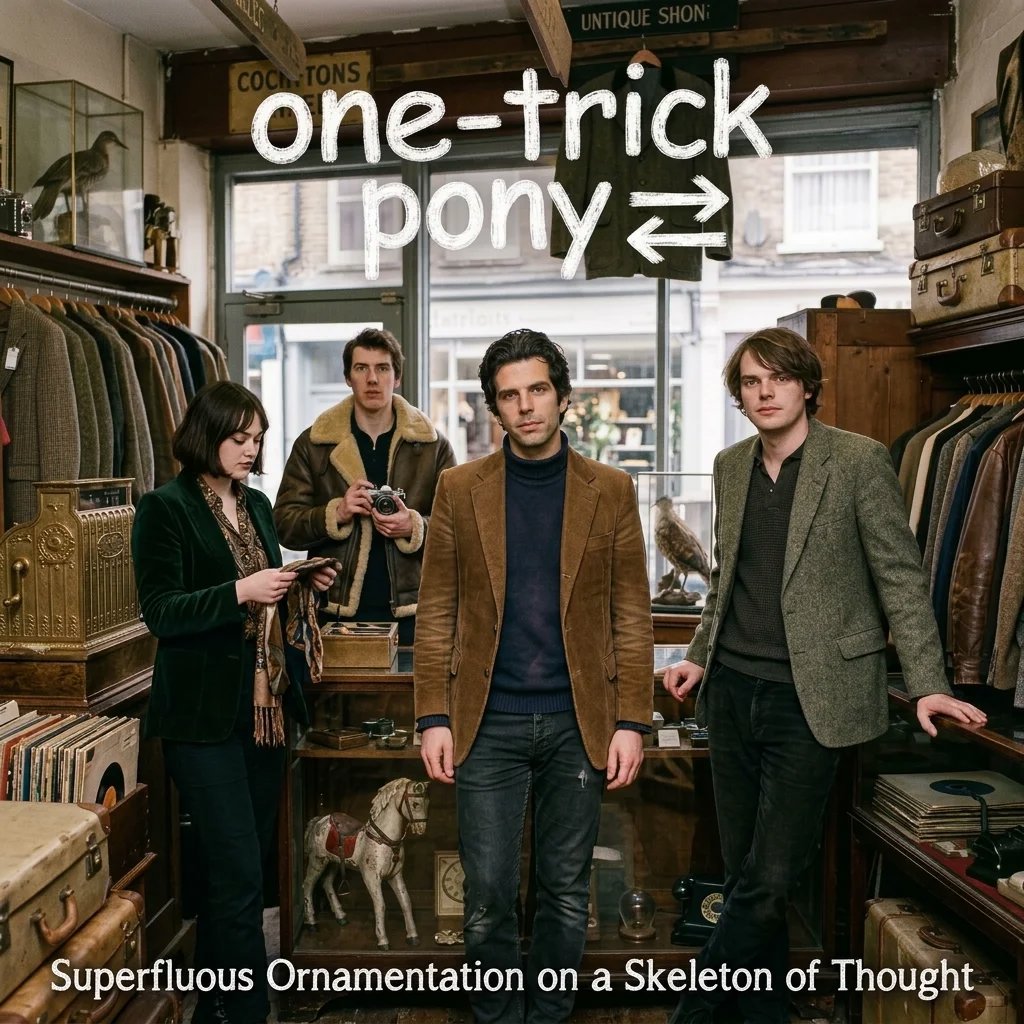
They named themselves before anyone else could do it for them. Every early review used the phrase anyway, so they took it, put it on the bass drum in white paint, and drew a double arrow beneath it. Forward and backward. The same idea, flipped and flipped again.
“It was a dare,” Cal says. “We were basically saying, go on, then, say it. We’ve already said it. Now what?”

The Formula
For years, the answer was: nothing, because it works.
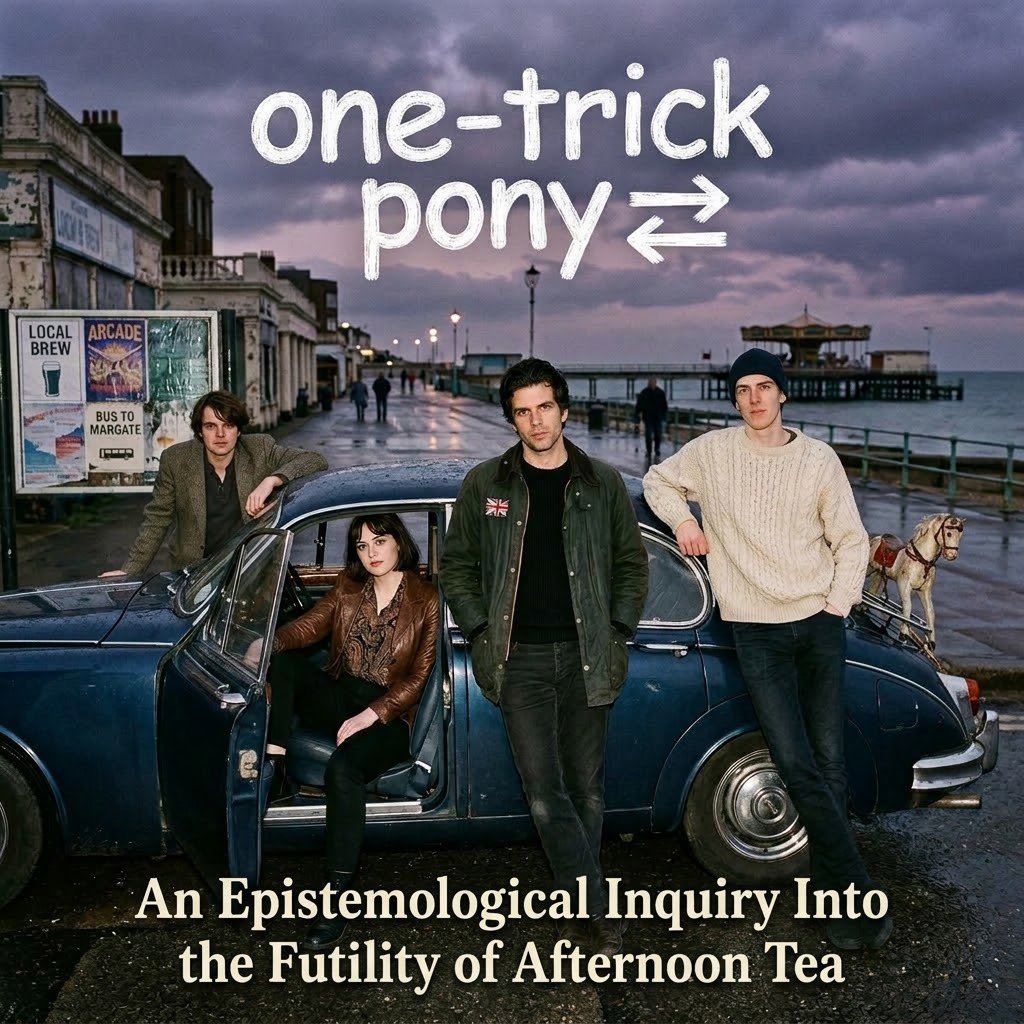
They recorded in a rented church hall with a leaking roof because the reverb was free. They refused the first three major-label offers, then a fourth, then a fifth, and wore their refusals like a uniform that wasn’t a uniform. The merch stall sold ticket-stub keyrings and a rocking-horse logo, a scuffed wooden thing with a Union Jack hoisted from its saddle like it had been through a war and kept riding.
The first number one came from a song Julian had nearly thrown away. By the fifth, there was a ritual: Julian would bring a skeleton of a song, Bea would bend it into shape, Cal would find the low-end ache beneath it, and Tobes would make it march.
It was a machine, and they loved it, until the day they didn’t.
The Breakdown
It happened in the church hall, of all places, in the dead week of February. They were three days into demoing the seventh album, and Julian had brought in what he knew was a perfect song.
He played it. They all knew it was perfect. It had the hook, the chant, the shrug.
And Bea put her guitar down.
“I couldn’t play it,” she says. “Not wouldn’t. Couldn’t. I knew every note before he’d finished the first verse. I knew my fill, Cal’s run, the exact moment Tobes would hit the crash. And I realised I wasn’t in the room. I was in the formula. We’d built a beautiful cage and I was the one holding the keys and I didn’t even want to open it.”
Julian, to his credit, didn’t argue.
“I’d been feeling it for two years,” he admits. “I’d sit down to write and the song would arrive fully formed, and that should have felt like a gift. It felt like a photocopy of a photocopy. Every song was a better copy of the last one, and none of them were new. I was terrified that if I said it out loud, the whole thing would fall apart.”
“So it fell apart anyway,” says Cal, “because Bea said it first.”
There was a shouting match, the kind that only happens between people who love each other and have run out of polite words. Cal threw a plectrum at the wall. Tobes, who never raised his voice, said quietly, “I haven’t played a fill I was surprised by since 2019,” and the room went silent.
“That was the worst part,” Tobes says. “Nobody was wrong. Nobody was the villain. We were four people who’d done the one thing so well that we’d accidentally welded ourselves into it.”
The Break
They didn’t split up. They’d discussed it, honestly and badly, over a long night and a cold takeaway, and none of them could say the word and mean it.
Instead Bea proposed the thing that became the poster.
“Not a hiatus. Hiatus is a word managers use when they’re hiding something,” she says. “A break. A proper one. Nobody writes for the band. Nobody calls each other to ask how the band is. We each go and do something that has nothing to do with the formula, and in a year, or two, or five, we find out whether there’s a reason to come back.”
They agreed on one rule: no new one-trick pony material until all four of them wanted it, not just one of them, and not because the label was asking.
So they went their own ways.
Julian rented a cottage on the Northumberland coast and tried to write nothing for six months. “It was horrible. I picked up the guitar and my hands just played the old chords. So I stopped playing guitar. I learned the piano badly. I wrote terrible songs on it. And for the first time in years, I didn’t know what a song was going to do. I was scared of them again. Scared in the good way.”
Bea went to Lisbon and joined a free-jazz collective that spoke very little English. “I was the worst musician in the room. Wonderful. I’d forgotten what that felt like. Someone told me to stop playing the notes I already knew, and I nearly cried, because it was the first honest note anyone’s given me in ten years.”
Cal took a job in a Leeds guitar repair shop and started teaching kids bass on Saturdays. “A twelve-year-old asked me why our songs always go back to the start. I said that’s the point. She said, ‘But what if it didn’t?’ I’ve thought about that every day since.”
Tobes bought a secondhand tape machine and a field recorder and spent a year walking the length of the country, recording whatever hit him: rain on a bus shelter, a market stall, a bin lorry at dawn. “I realised I’d spent my whole life keeping time for other people’s songs. Turns out the world has a pulse of its own. It doesn’t always play in four-four.”
What the Wall Said
A year and a half later, a poster appeared on the wall outside the Cornershop. No date. No venue. Just the double arrow, and the same six words, with one more line scratched in beneath it by hand:
We’re not coming back the same.
Nobody in the band will say who wrote it. Julian says it was Cal. Cal says it was Tobes. Tobes says it was Bea. Bea only smiles and says that some songs shouldn’t be credited.
What they will say is this.
“We were called a one-trick pony for fifteen years,” Julian says, “and the funny thing is, they were right. We had one trick. We just got so good at it we forgot it was a choice.”
“The pony’s still in the stable,” says Bea. “It’s just that now we’re not sure it’s a pony.”
“Maybe it’s a rocking horse,” Tobes adds. “Same horse. Different motion. Forward, back. Forward, back.”
Cal grins. “Or it’s a double arrow, mate. We just never read the second one.”
The tastemakers are waiting. The fans are waiting. The ticket stubs, faded and soft at the corners, are still pinned to the brick, somewhere in Salford, waiting for the next date.
But the band is not waiting. For the first time in their lives, they are simply going.